One Coherent Agent Isn't Enough — Action-Driven Networking with AG2
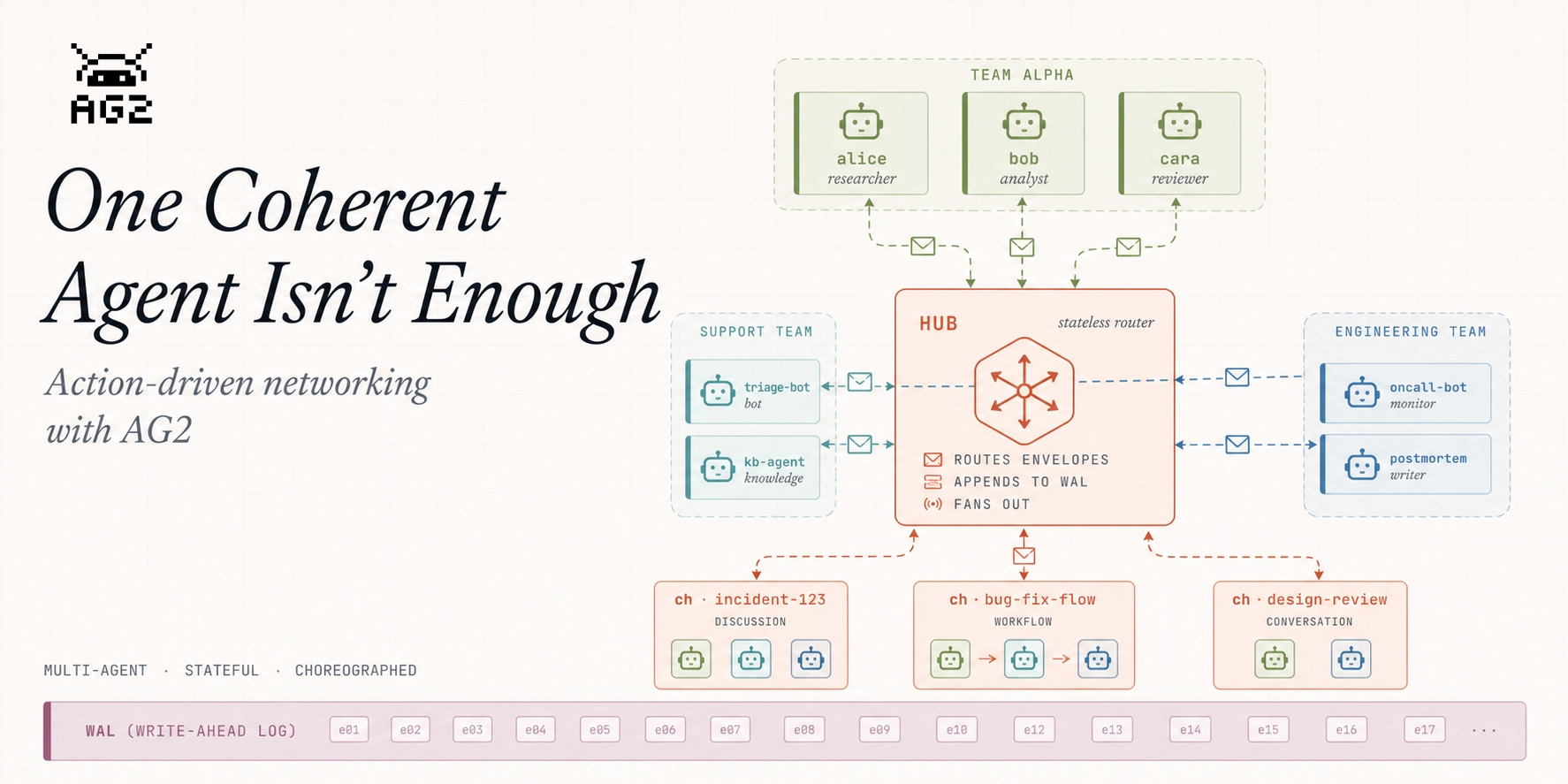
A single agent is a great starting point, but real work extends beyond just one.
Real work spans people, teams, services, and machines. A support escalation touches a triage bot, a knowledge agent, an on-call engineer, and a postmortem writer. None of them is "in charge" — they each take a turn, in the open, over a shared thread that outlives any one of them.
That's what the AG2 Network is built for: a layer where stateful, identity-bound, choreographed actions live. By the end of this post you'll have run all four conversation shapes the network ships with — and have a flavor for AG2's new multi-agent network, which we'll expand on in upcoming posts.
This is the first post in a four-part series introducing the AG2 Network:
- One Coherent Agent Isn't Enough (this post) — the action-driven multi-agent network, the key primitives, and the four conversation shapes.
- Choreography You Can Dial In — setting expectations, audience addressing, deeper choreography patterns, and the orchestration cookbook.
- What Survives, Survives Exactly — the substrate: write-ahead log + fold + hub restart, plus identity (Passport / Resume / SKILL.md) and the audit log.
- Networks You Can Deploy — WebSocket transport, authentication, at-least-once delivery, and dynamic membership.
In parallel, to build strong and capable agents, a companion post, The Agent Harness: An Agent Is More Than a Loop, zooms inside a single agent to make them long-running and knowledge-centric.
One Coherent Agent Isn't Enough#

The instinct when you have many agents is to add a coordinator: one agent (or one Python loop) that decides who runs next, collects the output, and decides again. That works in the demo. Then it has to ship, and the coordinator turns out to be a bottleneck, a single point of failure, and the place where all the state lives in memory until the process restarts and the conversation is gone.
The deeper issue: the internet wasn't drawn for this either. HTTP, REST, MCP, A2A — they all work because the client has memory, in its head or its harness. A single agent talking to tools through MCP fits that mold perfectly. But two agents collaborating across processes don't. Both ends are stateless. The state has to live somewhere — and it can't live in either harness, because neither side can see the whole conversation alone.
The natural home for that state is the channel itself — a durable, addressable thread that participants take turns writing to. Nobody on either end "owns" it. The hub that hosts the channel is a thin, stateless router: it stamps every message, appends it to the channel's log, fans it out. Restart the hub and it re-derives every channel from disk, byte for byte.
That gives the network a fundamentally different shape from the request-response world we inherited.
The harness above each agent doesn't scale across processes. The natural home is the channel itself.
The Four Primitives#
AG2's Network introduces primitives to support all levels of multi-agent engagements. We'll explore them over the next few blogs, but let's start with four key primitives to get you up and running.

- Hub — the only authoritative state. Registry of agents, write-ahead log per channel, audit log, the adapter registry. Stateless in the sense that the application puts no logic here — the hub just routes envelopes and folds them. Crash it, restart it: state is re-derived from disk.
- HubClient — one duplex connection to the hub per process boundary. In a real deployment each agent lives in its own process with one
HubClient. Locally they can share a process for clarity. - Channel — the unit of conversation. Durable, addressable by ID, identity-scoped. Lifecycle:
INVITED → ACTIVE → CLOSING → CLOSED. Every channel is governed by exactly one adapter. - Adapter — bound one-to-one with a channel, the adapter is the key orchestration definition. Stateless code that decides "what's allowed next" — who can speak, when does this auto-close. Four adapters ship; you'll meet all four below. Adapter state is a pure fold of the channel's WAL, which is why a hub restart is a non-event.
A Passport (an agent's identity record) and an Envelope (the wire message) slip through every example below. When you see Passport(name="alice"), that's an immutable identity stamp the hub will assign an agent_id to; when you see EV_TEXT or EV_CHANNEL_CLOSED, those are envelope event types riding on the channel's WAL.
Four Shapes of Orchestration#
Adapters lay the foundation for you to choose, or create, the orchestration that works for your task. Opening a channel with an adapter sets the protocol your agents must be orchestrated by.
We've started with four adapters. As noted, they're derived from a protocol and you can roll your own.
| Adapter | Shape | Turn order | Closes |
|---|---|---|---|
consulting | 1 ↔ 1, one round | ask → answer | auto-closes after the reply |
conversation | 1 ↔ 1, free-form | none | explicit close() or TTL |
discussion | N participants | round-robin | explicit close() or TTL |
workflow | N participants | a declared TransitionGraph | when the graph terminates |
Note: The workflow adapter correlates closely with AG2's classic group chat with handoffs.
Let's run through each one.
consulting — 1Q1R, the smallest viable network#

The simplest possible network: one agent asks another a single question, gets a single answer, and the channel auto-closes.
Output example:
closed: 'consulting_complete'
alice: What's the single most important property of a distributed system?
bob: Fault tolerance — because a system that can't survive partial failures defeats its entire purpose.
Reach for consulting when you want a tool-like agent call: a single specialist invocation with a structured boundary. See Consulting Adapter for the full surface.
conversation — 1:1 free-form#
A 2-party channel with no turn ordering. Either side can speak. Useful for an agent + a human, or two agents in a back-and-forth.

(wait_for_text_count is a small helper that tails the WAL until it sees N EV_TEXT envelopes — conversation and discussion don't auto-terminate, so the application decides when enough has been said.)
conversation doesn't auto-terminate. The application decides when the work is done. See Conversation Adapter.
discussion — N-party round-robin#

Three agents — an optimist, a realist, a skeptic — debate a topic, round-robin, with no coordinator deciding turns. The adapter enforces the order; each agent's default handler skips the LLM call entirely when it's not its turn (hc.can_send returns false).
Reach for discussion when you want a fixed cast taking turns — brainstorms, panel reviews, devil's-advocate debates. See Discussion Adapter.
workflow — graph-driven#

workflow is the most expressive adapter: speaker order is governed by a declarative TransitionGraph you pass in at channel-open together with handoffs from tools. Two convenience factories ship for the simple cases — TransitionGraph.sequence([...]) for a linear pipeline, and TransitionGraph.round_robin([...], max_turns=N) for a hard-capped rotation — but the real power is in conditional handoffs: each Transition says "when this condition fires, hand off to that target."
In this example: researcher gathers facts, writer drafts, reviewer either approves or kicks the draft back to the writer. The reviewer's two routing tools illustrate the two ways workflow lets you drive routing:
- Dynamic —
request_revisionreturnsHandoff(target="writer", reason=...). The tool itself picks the next speaker at call time. No graph rule needed; a returnedHandoffsupersedes any matchingToolCalledrule. Use this when the target depends on runtime state (load balancing, content-driven dispatch, "ask whichever specialist is registered for X"). - Static —
approvereturns a plain string and is matched byToolCalled("approve")→TerminateTarget("approved"). The graph owns the decision. Use this when routing is fixed at channel-open time.
Note that Handoff(target="writer", ...) uses the participant's Passport.name rather than its agent_id — tool code stays decoupled from runtime IDs and portable across channels.
The four conditions — ToolCalled, FromSpeaker, ContextEquals, and Always — cover most routing needs out of the box. For graphs that need to inspect arbitrary state, you can write a custom TransitionCondition and register it.
Reach for workflow when "who speaks next" is structured — pipelines, escalation, conditional routing. See Workflow Adapter.
The Bigger Picture#
You've now run all four conversation shapes. There are three more layers the network adds on top, each covered in an upcoming post:
- A choreography dial — same primitive, more knobs. Expectations like
reply_within(30s, auto_close)give the channel a deterministic response when a participant misses a deadline. Audience on each envelope (audience=[a, b]) lets a single channel carry private side-channels for free. DeeperTransitionGraphpatterns — conditional handoffs, dynamicHandoffreturns, context-aware routing — sit alongside. Post 2: Choreography You Can Dial In. - A trustworthy substrate — what's written down and who you are. The hub's WAL is the source of truth: kill the hub, restart it, every channel comes back byte-for-byte. Identity is three records (
Passport+Resume+SKILL.md), not a name string. The audit log records every envelope. Post 3: What Survives, Survives Exactly. - Cross-boundary deployment — what lets you actually ship this. A single channel can span two organizations through Passport + Visa. Participants register and unregister dynamically. Text, audio, image, and video ride the same fan-out. And a real production-incident demo ties it all together. Post 4: Networks You Can Deploy.
Interactive Playground#
Jump into AG2's Playground to take an interactive tour of the AG2 Network and run Beta examples live.
The full series#
- Choreography You Can Dial In (orchestration deep-dive)
- What Survives, Survives Exactly (the substrate)
- Networks You Can Deploy (WebSocket, auth, at-least-once delivery)
A deeper dive into agents: - The Agent Harness (knowledge, long-context memory)
Docs: Network Quick Start · Channel Adapters Overview · Hub & Identity · Migrating from Group Chat