Skip to content

Network#

What Survives, Survives Exactly

What Survives, Survives Exactly


Three agents are mid-conversation. The hub process restarts. When it comes back up, does the conversation survive?

Yes. Exactly as it was, envelope for envelope, in the same order, with the same adapter state. No partial log or replay from an approximation. The write-ahead log is the exact conversation.

The previous posts showed what the network lets agents do. This one explains why you can trust it.

Choreography You Can Dial In

AG2 Network — Choreography You Can Dial In


We've touched on the four built-in conversation shapes; now you need to make them survive contact with the real world.

In the first post — One Coherent Agent Isn't Enough — you opened a channel, watched agents take turns, and saw the hub fold envelopes into a durable thread. That's the shape. This post is about the dials on top of that shape — the knobs that turn a loose multi-agent free-for-all into something you'd actually run when an agent goes quiet at 2am, a step needs to time out, or a sub-conversation has to stay off the main thread.

One Coherent Agent Isn't Enough — Action-Driven Networking with AG2

AG2 Network — One Coherent Agent Isn't Enough

A single agent is a great starting point, but real work extends beyond just one.

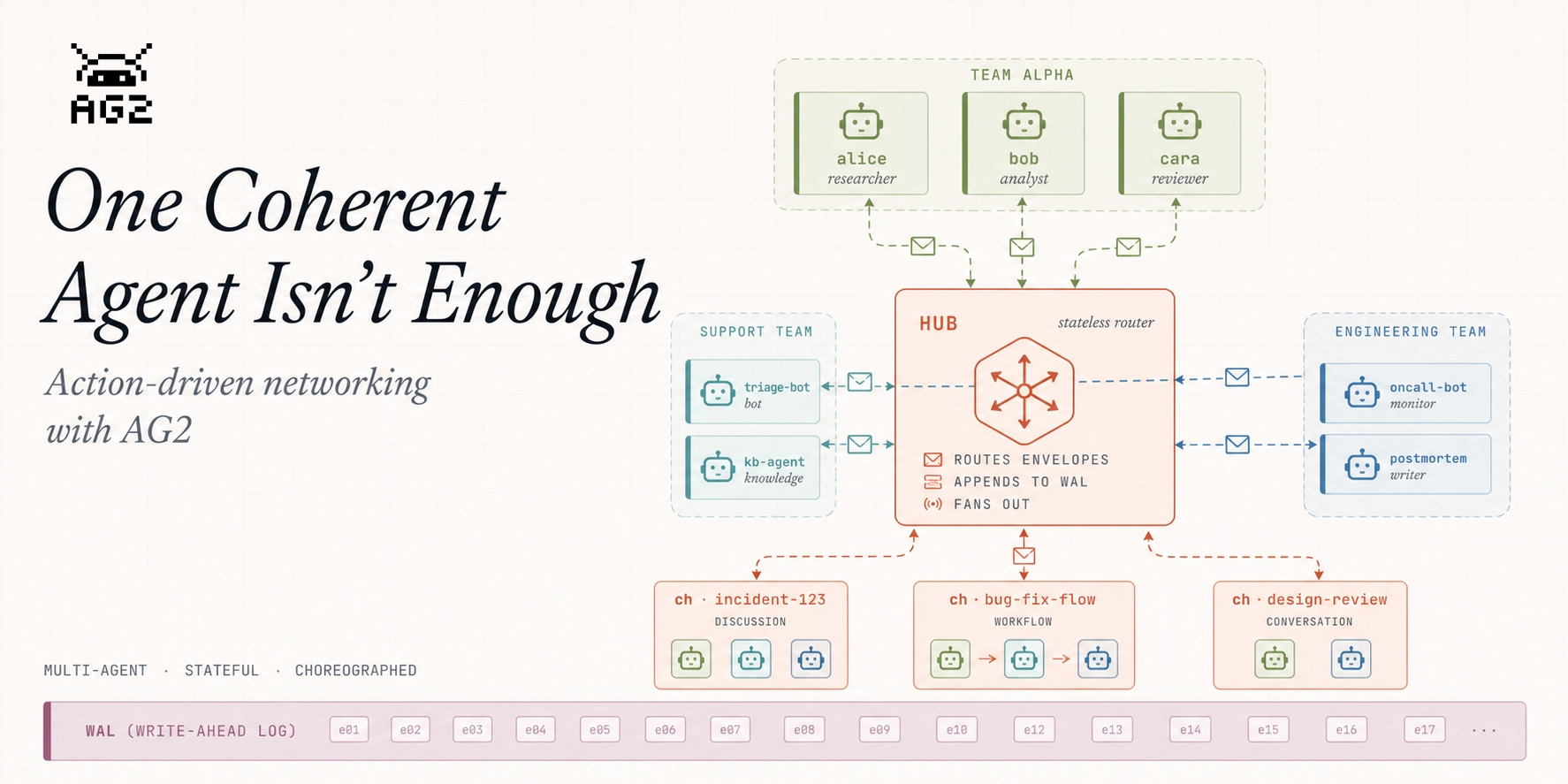
Real work spans people, teams, services, and machines. A support escalation touches a triage bot, a knowledge agent, an on-call engineer, and a postmortem writer. None of them is "in charge" — they each take a turn, in the open, over a shared thread that outlives any one of them.

That's what the AG2 Network is built for: a layer where stateful, identity-bound, choreographed actions live. By the end of this post you'll have run all four conversation shapes the network ships with — and have a flavor for AG2's new multi-agent network, which we'll expand on in upcoming posts.